A sneaker and a flat-pedal cycling shoe can look similar from a distance because both place a rubber sole between the foot and the ground. Under pedaling load, however, they are asked to do different jobs.
An everyday sneaker is designed to flex through walking and general movement, while a purpose-built cycling shoe has to keep the foot stable over a relatively small pedal platform, resist unwanted sole deformation, manage repeated pressure, and still provide enough traction for walking.
The distinction is not that one type of footwear is universally more comfortable. It is that the structures are optimized for different force paths. Once outsole architecture, pedal contact, heel control, closure tension, ventilation, and weight are considered together, the reason specialized flat-pedal footwear exists becomes much clearer.
Sole Flex Changes the Feel of the Pedal
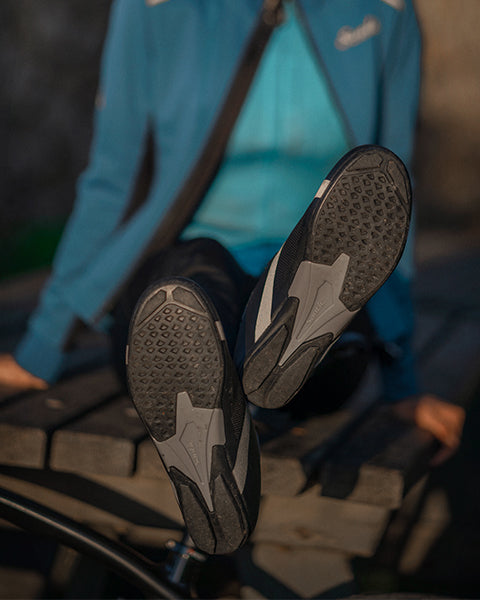
The largest structural difference is how the sole behaves under load. Ordinary sneakers tend to flex more readily, which is useful during walking but can make the pedal feel less defined when force is repeatedly applied through the forefoot. Purpose-built flat-pedal shoes use rubber combined with structural elements that reduce uncontrolled bending while preserving walkability.
A related off-road problem is addressed by women’s MTB shoes through recessed cleats, lugged traction, dirt drainage, and a sole that balances stiffness with enough flexibility for short walking sections. In both cases, the shoe is shaped around cycling rather than adapting a general-purpose walking sole to the bike. Lightweight road cycling shoes solve the pedaling problem differently by concentrating rigidity around a cleated road interface.
Road Shoes Place Stiffness Elsewhere
The contrast becomes sharper when lightweight road cycling shoes are compared with flat-pedal cycling shoes. A road-racing model may use a full-carbon outsole because the rider is connected through a cleat and does not need the broad rubber platform that a flat pedal requires. That carbon structure can be extremely rigid without providing sneaker-like walking behavior.
Flat-pedal footwear sits between those extremes: it needs more support than an ordinary trainer, but its outsole must remain a usable ground-contact surface. Specialized construction changes where and how stiffness is used. It is tuned to preserve pedal feel while still functioning away from the bike.
Grip Depends on Contact Geometry and Foot Retention
A sneaker outsole may provide reasonable friction on dry ground, yet that does not guarantee stable contact on a pinned platform pedal. Flat-pedal cycling footwear deliberately shapes the rubber surface around that interface. Santic’s Apollo 2.0, for example, uses a cleat-free rubber outsole with a raised-sheet form and diamond texture to increase contact, while an Atop micro-adjustable dial, a Velcro forefoot strap, and a V-heel cup control the foot above the sole.
Those features illustrate why women’s MTB shoes and flat-pedal models are treated as separate cycling categories rather than as ordinary casual footwear with a different upper. Lightweight road cycling shoes use a different outsole interface, yet they also depend on heel and closure control.
Internal Retention Completes External Grip
Retention is especially important because outsole grip cannot compensate for excessive movement inside the shoe. A heel that lifts, a loose forefoot, or uneven closure tension can allow the foot to shift even when the rubber remains planted on the pedal. With lightweight road cycling shoes, rigid soles are paired with precise closures, heel structures, and supportive insoles to keep the foot controlled over a cleated platform.
The pedal system differs, but the mechanical objective is similar: the foot has to remain in a controlled position relative to the sole. Specialized gear matters because both external grip and internal retention are designed around the same repeated pedaling motion. In women’s MTB shoes, internal retention likewise determines whether the intended outsole or cleat interface can be used consistently.
Purpose-Built Models Show Where the Extra Structure Goes
For women-specific flat-pedal use, Venus organizes Santic’s fit, support, and pedal-control features around a regular-last platform. Venus combines a regular last, medium toe box, five-star instep adjustability, Rubber 65A, a Rubber + TPU Shank outsole, a 240 g weight at size 38, and a City / Flat Pedal use classification.
Its upper uses electro-engraved ventilation holes and a wear-resistant matte surface, while the RB rubber sole has concave and convex forefoot grooves with central TPU reinforcement. A quick-turn ATOP closure, reinforced heel cup, and high-elastic heel foam reduce unnecessary heel movement. That collection of details shows how women’s MTB shoes and other cycling-specific models allocate structure to fit, support, airflow, and pedal control.
At the opposite performance end, Santic’s LS model demonstrates what changes when the design target becomes lightweight road cycling shoes. LS uses a stiffness-13 full-carbon outsole, a carbon sole listed at 67.5 g, and a complete single-shoe weight of 233 g.
Dual ETIE dials, a perforated upper, TPU toe and heel reinforcement, an arch-support insole, an asymmetric heel cup, and compatibility with Peloton, SPD-SL, and LOOK systems support a cleated racing interface. The comparison with a flat-pedal shoe is useful precisely because the two products distribute material differently. Specialized footwear is built around the pedal system and riding task rather than around a generic definition of “sport shoe.”
Sneakers can be comfortable and practical, but their flexibility and general-purpose outsole geometry are not designed specifically for repeated flat-pedal loading. Cycling shoes add structure where pedaling creates demands: the sole, pedal-contact surface, closure, heel, ventilation zones, and fit volume.
Flat-pedal models keep rubber and walkability while controlling flex and foot movement; road models can move further toward carbon stiffness because the cleat supplies the pedal connection. Specialized gear matters because its components answer cycling-specific force and contact conditions, not because the shoe merely looks different. Feature-by-feature comparison works best when each component is tied to the cycling task it performs instead of to appearance alone.
