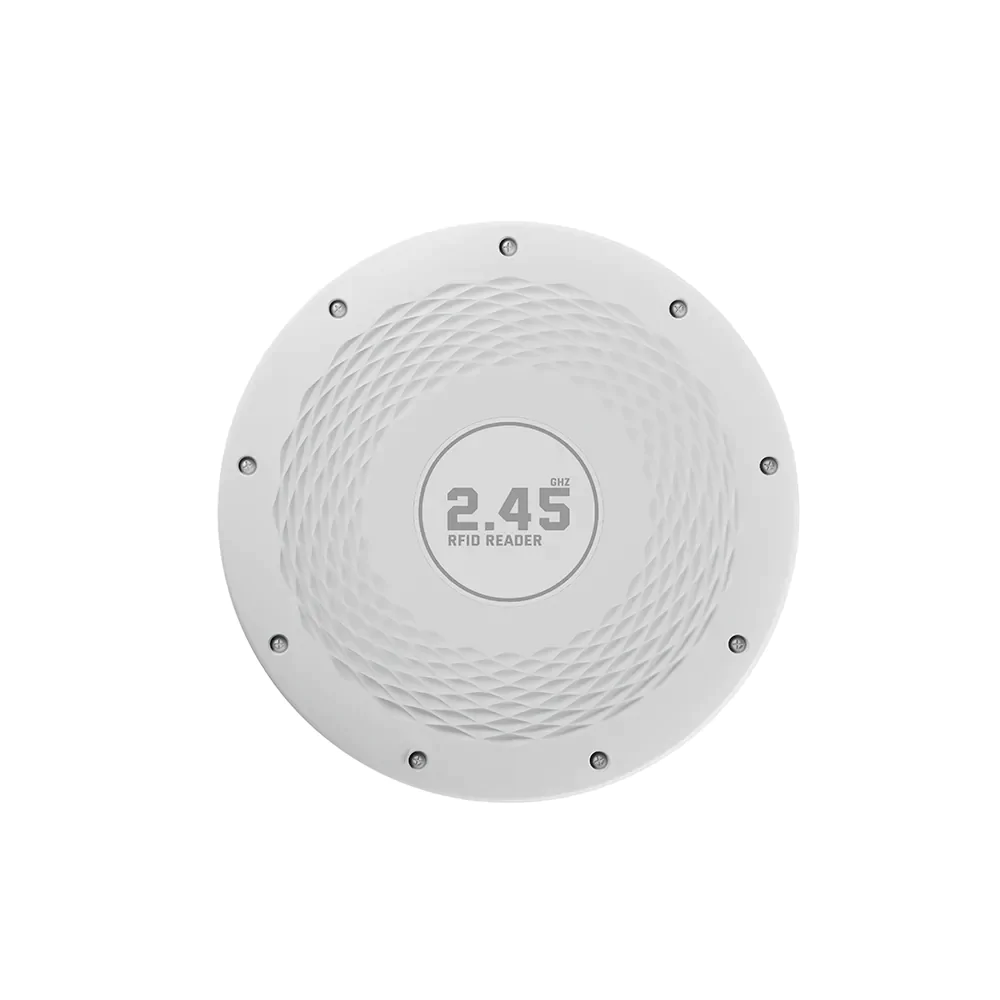
Choosing an RFID reader by advertised read distance alone can produce a misleading comparison. Two readers may both claim long-range identification while differing substantially in RF output control, receive sensitivity, antenna connectivity, processing capacity, interfaces, and environmental tolerance. For industrial deployments, those specifications determine whether a reader can create a controlled and reliable identification zone.
The distinction between the best RFID readers and mid-range models therefore starts with the complete technical architecture, not a single headline number.
Read Range Is Only the Starting Specification
Read distance is useful, but it should be treated as a system result rather than an isolated reader characteristic. Antenna gain, tag construction, tag orientation, reader power, installation geometry, and surrounding materials all affect the actual distance achieved.
RSTC’s RS-F905, for example, specifies a reading distance of up to 25 meters depending on antenna configuration. It also provides adjustable output power from 5 dBm to 33 dBm in 1 dBm steps.
That distinction matters in warehouse portals and vehicle identification points. A reader that simply produces maximum RF power may create an unnecessarily large read zone. Adjustable power gives system designers greater control over where tag detection begins and ends.
RF Control Determines the Usable Read Zone
Output power becomes more meaningful when it can be adjusted precisely. A configurable RF output can help installers tune coverage around doors, conveyors, production stations, or other defined read points.
The RS-PR03, for instance, specifies +20 dBm to +30 dBm output with 1 dBm adjustment steps. Its documentation also lists FHSS or fixed-frequency operation.
Such controls become valuable in installations containing several readers. Poorly controlled RF zones can increase the possibility of unintended tag detection or interference between nearby reading points. Frequency management and power adjustment consequently belong in a serious technical comparison.
Receive Sensitivity Reveals Weak-Tag Performance
Transmit power attracts attention because it is easy to compare. Receive sensitivity is less visible but equally important because a reader must detect the relatively weak signal returned from a tag.
The RS-F905 specifies receive sensitivity below -80 dBm, while the RS-PR03 lists below -70 dBm. These figures should not be interpreted as direct guarantees of field performance, because complete RFID performance depends on the reader, antenna, tag, environment, and configuration.
A stronger receiver can become particularly relevant where tags are distant, poorly oriented, partially obstructed, or operating around difficult materials. Engineers comparing best RFID readers should therefore examine both transmission capability and receiver performance.
Antenna Architecture Affects Coverage Flexibility
A reader with multiple external antenna ports can provide substantially more installation flexibility than an integrated unit designed around a fixed antenna arrangement.
The RS-F905 provides four external antenna ports using SMA connectors. That architecture permits antennas to be positioned around a doorway, production line, storage area, or other reading zone.
Integrated readers can still be appropriate where compact deployment is more important. RSTC’s RS-PI09CA01 combines a reader with a built-in 9 dBi circular-polarization antenna and specifies a reading range of up to 8 meters, depending on antenna configuration.
Consequently, antenna architecture should be evaluated against the physical geometry of the read point rather than judged as inherently better or worse.
Multi-Tag Processing Matters at Busy Read Points
Warehouse and logistics applications rarely involve a single isolated tag. Pallets, cartons, vehicles, and equipment can place multiple tags inside the RF field simultaneously.
The RS-PR03 specifies multi-tag identification and provides a tag protocol based on EPC Class 1 Gen 2 / ISO 18000-6C. Its published reading range is up to 15 meters depending on antenna configuration.
Another RSTC model, the RS-PR01, specifies a peak inventory speed above 700 tags per second and a buffer capacity for 1,000 tags at 96-bit EPC.
Numbers such as these become meaningful when matched to the expected tag density and movement speed at a read point. A reader intended for high-volume inventory capture should be evaluated differently from one serving a controlled workstation.
Industrial Interfaces Separate Deployment-Ready Hardware
Communication options can determine whether an RFID reader integrates cleanly into an existing industrial architecture. Ethernet, RS-232, RS-485, GPIO, relay outputs, and optional wireless interfaces serve different integration requirements.
The RS-F905 supports RJ45, RS-232, and RS-485, with optional 4G and Wi-Fi connectivity. It also provides relay outputs and optically isolated inputs.
Software support matters alongside physical interfaces. The RS-PR03 provides Ethernet, USB 2.0, and RS-232, with optional RS-485 and Wiegand interfaces, while its platform includes C++ and C# API development support.
That combination can matter more to a system integrator than an extra meter of theoretical range.
Environmental Specifications Indicate Where a Reader Can Operate
Industrial RFID equipment may encounter temperature variation, moisture, dust, vibration, and other environmental stresses. Consequently, enclosure ratings and operating-temperature specifications should be compared alongside RF characteristics.
The RS-F905 specifies an operating temperature of -20°C to +60°C and IP54 protection, with IP65 possible using a waterproof housing. The RS-PR03 specifies -40°C to +60°C and IP54, also noting IP65 availability with waterproof housing.
RSTC‘s reader portfolio spans fixed UHF, integrated UHF, active RFID, and handheld configurations, reflecting different installation requirements rather than one universal reader design.
The Better Specification Sheet Is the One That Matches the System
A technically stronger reader is not necessarily the unit with the highest advertised range or output power. Engineers should examine the interaction among RF power control, receive sensitivity, antenna ports, tag-processing capability, communication interfaces, software support, and environmental specifications.
For a warehouse portal, multi-antenna flexibility and controlled RF coverage may matter most. A compact workstation may favor an integrated antenna. A harsh industrial installation may place greater emphasis on temperature and ingress protection. For a broader selection framework, see RSTC’s guide to choosing a UHF RFID reader for industrial applications.
RSTC’s specifications illustrate why reader selection should be treated as a system-engineering decision. The most capable model is ultimately the one whose technical architecture fits the read zone, tag population, integration method, and operating environment without introducing unnecessary complexity. That is a more reliable basis for distinguishing high-performance RFID equipment from mid-range hardware than comparing a single specification in isolation.
