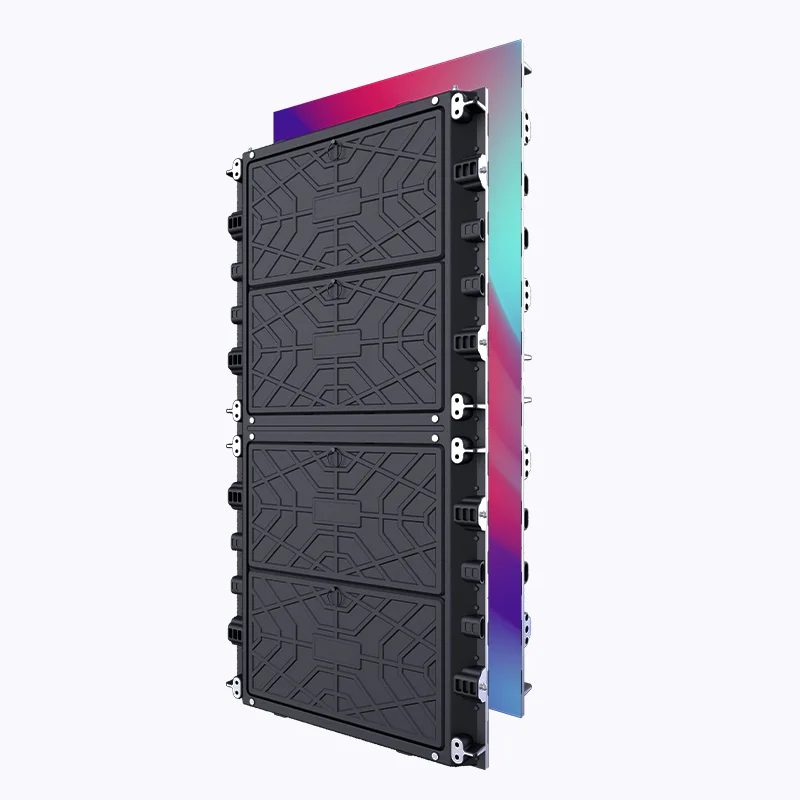
Indoor LED display solutions are increasingly used in corporate meeting rooms, broadcast studios, control rooms, retail spaces, museums, and event venues. Yet the visible LED modules are only one part of the system. The control architecture determines how video signals are processed, distributed, synchronized, and reproduced across the screen. For B2B buyers, understanding this layer is essential when evaluating image quality, reliability, scalability, and maintenance.
How an LED Control System Works
A typical LED control system connects the video source to the LED cabinets through several coordinated components. A video processor can accept and manage multiple inputs, scale content to the required resolution, and switch between sources. A sending card then transmits processed image data toward receiving cards installed within the cabinets.
Receiving cards perform a particularly important role. They decode incoming data and distribute it to LED modules and driver circuits so that individual pixels display the intended brightness, color, and timing. Modern receiving cards can also support functions such as calibration, monitoring, mapping, and redundancy. The exact configuration depends on the display architecture and application requirements.
Why Control Matters for Indoor LED Displays
For indoor LED displays, the control system needs to match the screen’s pixel density and viewing environment. Fine-pitch products are commonly selected for applications where viewers stand relatively close to the screen, making uniformity, grayscale performance, and stable image reproduction especially important.
The processor and sending architecture must also handle the display’s total pixel load. A mismatch can limit the usable resolution or create unnecessary constraints when the wall is expanded. Buyers should therefore assess the complete signal chain instead of selecting a cabinet first and treating control hardware as an afterthought.
Refresh rate is another consideration, particularly where cameras are involved. Broadcast, studio, and event applications may expose flicker or scanning artifacts that are less noticeable to the naked eye. A suitable control system, combined with compatible receiving cards and LED modules, helps the display reproduce camera-facing content more reliably.
Redundancy for Mission-Critical Applications
Not every indoor installation requires the same level of protection against equipment failure. A corporate information wall may tolerate a short interruption, while a television studio or live production environment may not. For these applications, redundancy can be built into the control architecture.
Receiving-card redundancy and power-supply backup can provide an additional layer of operational protection. Some receiving-card platforms support dual backup functions, while control systems may also support configuration and firmware backup. These features can reduce the impact of a failed component and simplify recovery.
This is particularly relevant for uninterrupted live broadcast. When an indoor LED display is used behind presenters, as a production backdrop, or within a studio workflow, an unexpected black screen can affect the entire production. Specifying backup capability at the planning stage is therefore more practical than attempting to retrofit resilience after installation.
Matching Control Systems to Application Needs
B2B buyers should begin with the operating scenario rather than simply choosing the highest-specification controller. A conference-room wall may prioritize straightforward switching and stable everyday operation. A retail display may place greater emphasis on consistent color and content flexibility. Broadcast environments typically require more attention to synchronization, redundancy, camera compatibility, and signal reliability.
The physical scale of the wall matters as well. Larger indoor LED displays increase the number of pixels that the control system must manage. The number of sending outputs, receiving-card capacity, transmission method, and processor capability should be evaluated together. This approach helps integrators avoid both under-specification and unnecessary hardware costs.
Coblinks MC Series for Fine Indoor Displays
Coblinks is a technology-driven LED display manufacturer specializing in indoor and outdoor fixed-installation and rental displays, supported by complete SMT production lines and advanced manufacturing equipment. Its MC Series is designed for different fine indoor display applications and is available in pixel pitches from P1.25 to P3.9mm.
For projects requiring high operational reliability, the MC Series offers an optional dual backup of the receiving card and power supply. This is particularly relevant for museums, where indoor LED displays are often used to present digital exhibitions, historical content, and interactive visual experiences. In these environments, stable image output, accurate color reproduction, and reliable long-term operation are important for maintaining a consistent visitor experience.
By considering backup functions and control-system reliability during the planning stage, integrators can build display solutions that support continuous operation and reduce potential disruptions after installation.
Building a More Reliable Indoor LED Display System
A successful indoor LED display project depends on more than cabinet appearance or pixel pitch. The control system influences how efficiently signals reach the modules, how consistently content is reproduced, and how the installation responds when a component requires attention. For integrators and project owners, these factors directly affect long-term operating confidence.
The right architecture should therefore be selected around application, pixel load, signal sources, viewing conditions, redundancy requirements, and future expansion. With these parameters established early, indoor LED displays can be configured with control hardware that supports their intended performance instead of becoming a limiting factor.
For businesses seeking a manufacturer with integrated production capabilities, Coblinks develops high-quality indoor and outdoor LED display products and customized solutions. Its MC Series covers fine indoor applications from P1.25 to P3.9mm, with optional receiving-card and power-supply dual backup for demanding installations. Contact Coblinks to discuss a suitable indoor LED display solution for your project.
