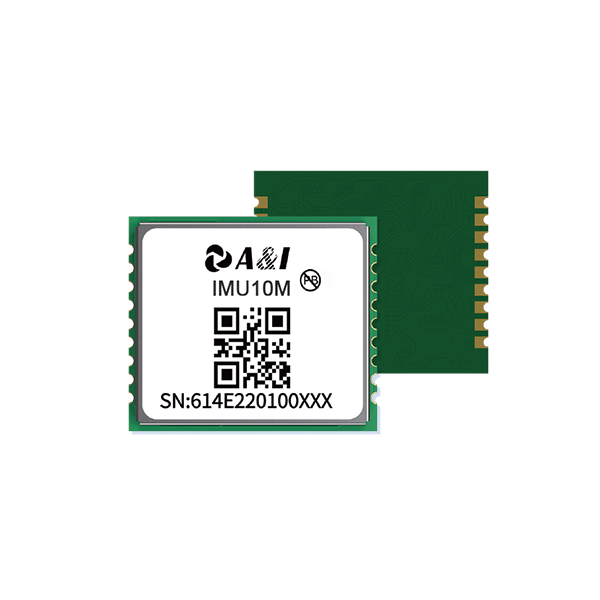
A mobile device may move in three different directions and spin on three different axes at the same time. It takes more than one measurement to capture all six movements. By integrating a three-axis accelerometer with a three-axis gyroscope, a six degrees of freedom sensor may measure both linear acceleration and angular velocity at the same time.
The underlying principle is straightforward, but turning those measurements into useful real-time motion information requires careful sensing, calibration, signal processing, and integration. Archimedes Innovation develops inertial and navigation technologies for applications where accurate motion and orientation information are part of a larger positioning or control system.
Six Motion Components Are Measured Through Two Sensor Families
Six degrees of freedom refers to three translational and three rotational components. Translation describes movement along the X, Y, and Z axes, while rotation describes angular motion around those same axes.
A MEMS inertial sensor can combine the sensing elements required to observe these components in a compact package. The accelerometer responds to linear acceleration along three orthogonal axes. The gyroscope independently measures angular velocity around those axes.
That separation is important because acceleration and rotation represent different physical quantities. A vehicle turning around a corner may experience relatively little vertical acceleration while simultaneously producing substantial angular motion around its vertical axis. Measuring both gives the navigation system a more complete description of what the platform is doing.
Accelerometers Capture Translational Motion
Inside a MEMS accelerometer, microscopic mechanical structures respond to acceleration. Movement changes the position or force state of the sensing structure, and electronics convert that physical change into a measurable electrical signal.
Three sensing axes provide acceleration information along X, Y, and Z. Those measurements describe how the body’s velocity is changing rather than directly reporting its traveled distance. Software can process the acceleration over time to estimate changes in velocity and, under appropriate conditions, changes in position.
Practical inertial measurement therefore depends heavily on calibration and error management. Small biases in acceleration can accumulate when measurements are integrated over time. For that reason, accelerometer data is often combined with external positioning or other navigation references instead of being treated as a completely independent source of long-term position.
Gyroscopes Capture Rotation Around Three Axes
The rotational half of the measurement system comes from three-axis gyroscopes. Rather than measuring angular position directly, a gyroscope measures angular velocity—the rate at which the sensor rotates around each axis.
Those three measurements describe roll, pitch, and yaw motion. A processing system can integrate angular-rate information to estimate changes in orientation. That makes gyroscopes particularly useful when a machine needs to know not only where it is, but also which direction its body is pointing and how quickly its orientation is changing.
The M992-INS from Archimedes Innovation, for example, incorporates an IMU with a three-axis gyroscope and three-axis accelerometer, with published gyroscope measurement capability of ±300°/s and accelerometer measurement capability of ±6g.
Sensor Fusion Turns Raw Measurements Into Motion Information
Raw inertial measurements are not automatically equivalent to a complete navigation solution. Processing is needed to compensate for sensor characteristics, transform measurements between coordinate frames, and combine information over time.
A major challenge is that inertial errors accumulate. External references such as GNSS can provide an absolute spatial reference, while inertial measurements provide high-rate information about short-term motion. Combining them can produce a more useful estimate than relying exclusively on either source.
This is where a MEMS inertial sensor becomes particularly valuable in integrated navigation. The M992-INS uses tightly coupled GNSS and inertial navigation and supports high-frequency positioning and orientation outputs. Its published specifications list INS raw observations at up to 1 000 Hz and typical fusion‑position‑and‑orientation output at 200 Hz.
Such high-rate output can give downstream control systems frequent updates about the platform’s motion state. The exact benefit depends on the application, processing architecture, and sensor configuration.
Why Real-Time Output Depends on More Than the Sensors?
Fast measurement alone does not guarantee useful real-time motion information. Latency, synchronization, calibration, communication interfaces, sensor noise, and algorithm performance all influence how quickly and accurately data reaches the application.
Timing is particularly important when inertial measurements are combined with cameras, LiDAR, GNSS, or vehicle-control systems. Measurements from different sensors must correspond to compatible points in time if the combined estimate is to represent the same physical state.
The M992-INS supports PPS, NTP, and PTP synchronization and can provide positioning and orientation information at high output rates. Its interfaces include RS232, RS422, CAN, and Ethernet, allowing the navigation module to communicate with other system components.
What the Six-Axis Architecture Enables in Moving Systems?
A six-axis measurement architecture provides the motion foundation for applications that require continuous awareness of how a platform is moving and rotating. Autonomous vehicles can use inertial information to support navigation and control, while robots can use it to estimate body motion and orientation.
The same principle extends to marine robotics, aerial mapping, industrial vehicles, and machine-control systems. Archimedes Innovation lists autonomous driving, port and mining automation, hydrographic surveying, marine robotics, and aerial mapping among applications for its GNSS/INS technology.
The key distinction is between measurement and estimation. Accelerometers and gyroscopes directly sense specific aspects of motion; algorithms then process those observations to estimate the platform’s broader state.
Consequently, a six degrees of freedom sensor measures translation and rotation in real time by using three accelerometer axes for linear acceleration and three gyroscope axes for angular velocity. Processing these measurements provides continuous motion information, while fusion with external references can reduce the limitations associated with inertial drift.
For engineers selecting inertial hardware, the meaningful question is therefore not simply whether a sensor has six axes. Measurement ranges, bias stability, noise characteristics, output frequency, synchronization, interfaces, calibration requirements, and integration with other navigation sensors determine how effectively those six measurements can support the intended system.
A well-designed six-axis architecture gives autonomous machinery the high-rate motion awareness needed to respond to movement as it happens.
