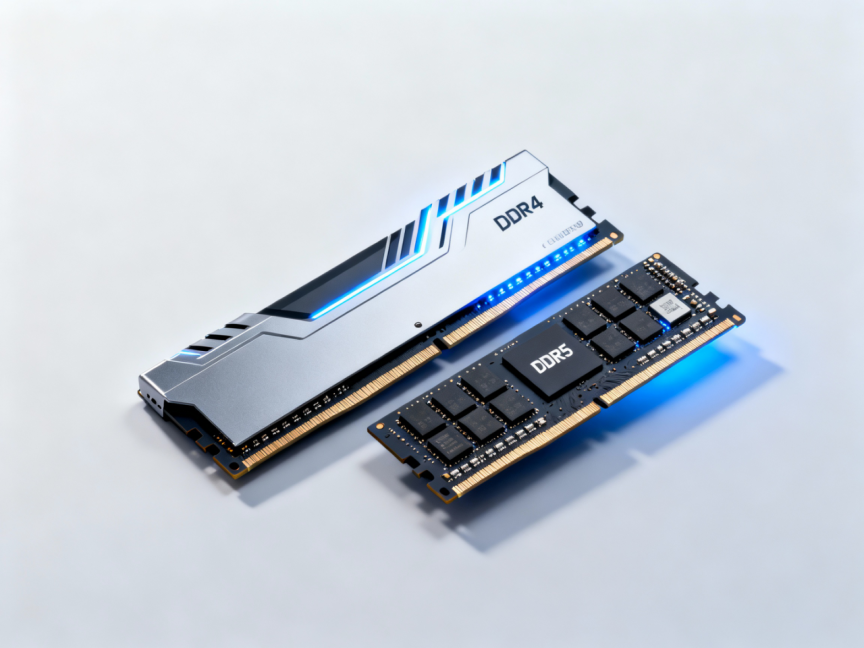
In 2025, the memory market presents a unique paradox where newer technology does not strictly guarantee faster response times. While DDR5 has become the standard for bandwidth-heavy workflows, the best DDR4 ram kits often retain a significant advantage in absolute latency. For PC gaming enthusiasts and competitive esports players, this distinction is critical. High-bin DDR4 modules, particularly those utilizing Samsung B-die integrated circuits, can deliver tighter timings than the loose JEDEC standards of entry-level DDR5-4800, creating a compelling case for maximizing legacy platforms.
Technical Latency Comparison Between Memory Generations
To understand why older technology can outperform newer standards, one must analyze the mathematical relationship between frequency and CAS latency (CL). Higher transfer rates do not automatically equate to faster data access if the timings are proportionally looser.
Calculating Absolute Latency Metrics
The true speed of memory is defined by its absolute latency in nanoseconds, calculated using the formula: Latency (ns) = (CAS Latency × 2) ÷ Frequency (GHz). Applying this to a premium DDR4-3600 CL14 kit reveals a first-word latency of approximately 7.7 nanoseconds. In stark contrast, a standard DDR5-4800 CL40 module yields a latency of roughly 16.66 nanoseconds—more than double the delay. Even as DDR5 speeds increase, the best DDR4 RAM has approximately 53% lower latency than DDR5-4800 CL40, which is crucial for fast system response.
Memory Controller Gear Modes and Efficiency
Beyond raw module specifications, the memory controller configuration plays a decisive role. DDR4 platforms, particularly on Intel’s 12th through 14th Gen CPUs, can operate in “Gear 1” mode, where the memory controller runs at a 1:1 ratio with the DRAM frequency. This synchronization minimizes internal communication delays. Conversely, DDR5 designs mandate “Gear 2” or “Gear 4” modes to sustain high frequencies, introducing a latency penalty as the controller runs at half or quarter speed. For users seeking the DDR4 best ram performance, staying in Gear 1 often yields better results than upgrading to early-generation DDR5.
Real-World Gaming Performance and Platform Optimization
Theoretical metrics translate directly into gaming experiences, especially in CPU-bound titles where the processor waits for data from memory. Optimizing for low latency often yields smoother gameplay than chasing peak bandwidth.
In competitive shooters like Valorant or Counter-Strike 2, DDR4 CL14-CL16 can reduce frame time fluctuations (stuttering) by up to 30% compared to DDR5-4800 CL40. While the average FPS might be similar, DDR4 ensures a smoother gaming experience during intense action sequences. Therefore, for budget-conscious gamers who prioritize stability, purchasing the best DDR4 memory is a wise choice.
AMD Ryzen Optimization
For gamers using the AM4/Ryzen platform, choosing the best DDR4 memory for Ryzen processors requires adhering to the limitations of the Infinity Fabric (FCLK) architecture. DDR4-3600–3800 MT/s perfectly matches the Infinity Fabric (FCLK), achieving a 1:1:1 ratio for maximum efficiency. DDR5, however, disrupts this synchronization, introducing latency of up to 10 ns due to clock desynchronization. Therefore, choosing high-quality DDR4 memory ensures the processor operates at peak efficiency, avoiding the synchronization bottlenecks inherent in mixed ratio settings.
UniBetter Electronic Component Procurement Solutions
UniBetter serves as a premier global distributor, specializing in supply chain solutions that help manufacturers and businesses secure authentic electronic components, including hard-to-find memory ICs and legacy processors.
Ensuring Authenticity and Global Sourcing
Witha global network of over 1,000+ audited premium suppliers and a proprietary CSD Quality Management System, UniBetter guarantees 100% authenticity for every component distributed. The company excels in locating obsolete or allocated parts, such as specific high-performance DDR4 DRAM chips or PMICs required for industrial applications. By leveraging a global procurement infrastructure spanning Shenzhen, Hong Kong, Singapore, and Thailand, UniBetter provides clients with cost-effective sourcing strategies and shortage management. This service-oriented approach ensures that businesses can maintain production lines without the risk of counterfeit components, securing the integrity of their final electronic assemblies.
