In the highly competitive landscape of commercial garment decoration, maximizing operational throughput is the primary driver of profitability. As B2B printing enterprises scale production volumes to meet demands of corporate clients and retail fulfillment, the focus naturally shifts to optimizing equipment speed. However, a frequently overlooked element in the direct-to-film workflow that drastically influences overall production speed is the quality of the hot melt adhesive. For industrial print shops utilizing automated shaker and baking units, the chemical and physical properties of the DTF printer powder dictate whether a production line runs seamlessly or suffers from constant micro-stoppages. When analyzing the return on investment for high-end printing hardware, managers must evaluate how consumable materials restrict or unleash the machine’s true capacity. Understanding the mechanical interaction between adhesive particles, printed film, and the curing environment is essential for eliminating bottlenecks. By prioritizing high-grade adhesive formulations, facility operators can significantly enhance daily output, reduce manual labor interventions, and maintain the stringent quality control standards required for large-scale commercial contracts.
Particle Size Uniformity and Automated Application Speed
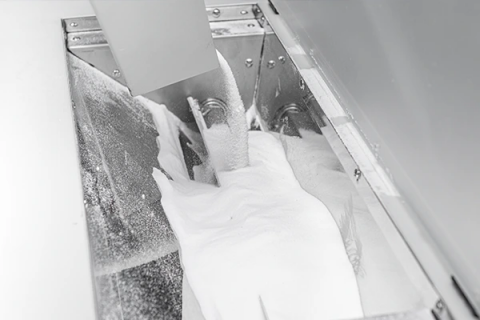
The foundation of an efficient direct-to-film production line lies in the automated application phase, where printed PET film passes through the powder shaker. During this stage, uniformity of the adhesive particle size is a critical operational metric. Industrial-grade formulations are engineered with consistent micron distributions, ensuring that the powder flows fluidly from the hopper onto wet ink without forming clumps. When a facility utilizes an adhesive with erratic particle sizes, the shaker mechanism struggles to maintain an even coat, requiring operators to frequently pause the machine to clear blockages or manually adjust the distribution blade. These interruptions severely degrade the prints-per-hour metric. Conversely, uniformly milled adhesive creates a smooth, continuous curtain of powder that adheres perfectly to the ink while vibrating off unprinted areas. This seamless mechanical flow allows the automated shaker line to run at its maximum calibrated speed, ensuring the printer does not have to be throttled back to accommodate a sluggish application process. Ultimately, material consistency translates directly into mechanical reliability and sustained high-speed production.
Anti-Static Formulations Minimizing Equipment Downtime
One of the most pervasive threats to printing efficiency in a high-volume B2B environment is the generation of static electricity during the film transit process. As the PET film moves through the printer and enters the shaker basin, friction naturally creates a static charge that can cause standard adhesive particles to aggressively cling to areas of the film where no ink is present. If this excess powder is not removed before the curing phase, it melts onto the final garment, creating unacceptable artifacts that result in rejected products and costly reprints. To combat this, premium adhesives are engineered with advanced anti-static treatments that neutralize the electrical charge upon contact. This chemical advantage ensures that the powder only bonds to the wet ink, allowing the excess to fall cleanly back into the recycling tray as the film passes over the vibration beaters. By eliminating static cling, operators do not have to manually pause the line to wipe down the film or clean the interior sensors of the shaker unit. This reduction in manual intervention dramatically minimizes equipment downtime, keeping the entire production pipeline moving smoothly and ensuring that labor resources are allocated to machine operation rather than constant troubleshooting.
Optimized Melt Index for Accelerated Curing Cycles
The final bottleneck in the direct-to-film workflow is the curing oven, where the speed of the conveyor belt is strictly limited by the time required to properly melt the adhesive. The thermodynamic properties of the chosen DTF powder play a decisive role in determining this maximum processing speed. High-quality adhesives are synthesized with a highly specific and stable melt index, typically formulated to transition from a solid to a viscous bonding state rapidly and uniformly at precise temperatures. When an adhesive boasts a narrow melting range, the curing oven does not need to be set to excessive temperatures or run at a lethargic pace to guarantee complete activation. Instead, operators can increase the speed of the conveyor belt, significantly boosting the linear meters processed per hour without risking under-cured prints that would fail subsequent wash fastness tests. Furthermore, a highly responsive melt index prevents the adhesive from over-baking, which can cause the powder to degrade or the underlying ink to shift color profiles. By aligning the thermodynamic behavior of the adhesive with the maximum output capabilities of the curing oven, B2B print shops can achieve a highly synchronized, accelerated workflow that maximizes daily production quotas.
Material Yield and Long-Term Operational Profitability
Achieving maximum printing efficiency is not solely about the speed of the machinery; it is equally dependent on maximizing material yield and minimizing defect rates. Premium adhesive formulations boast exceptional recycling efficiency within the automated shaker system, meaning that unused powder falling into the collection tray remains uncontaminated and viable for continuous reuse. Lower-quality alternatives often degrade, clump, or absorb humidity during the recycling loop, requiring operators to frequently dump the basin and halt production to load fresh materials. By utilizing a highly stable, humidity-resistant adhesive, commercial facilities can run extended shifts with minimal material waste. This high yield directly lowers the cost-per-print, a crucial metric for securing competitive B2B contracts and bulk apparel orders. Combined with the elimination of static-related defects and the acceleration of the curing phase, the strategic selection of printing consumables proves to be a foundational element of industrial profitability. Printing efficiency is achieved through a holistic approach where superior chemical formulations empower high-end mechanical hardware to operate continuously at peak performance.
