At a planned laboratory test point, the applied value and the independently observed result need to remain identifiable. The source setting, the device’s indication and the comparison reading describe different observations made during the same experiment.
Equipment selection can begin with that small set of records, then establish which ranges and conditions support them. Following one test point through excitation, observation and recording gives the calibration bench a concrete structure.
Build the Test Point Before the Equipment List
A test record can place the intended setting beside the device indication and the independent reading. A reference meter supplies that additional observation, with its selected input range identified alongside the output configuration.
If one instrument both generates a signal and measures an input, the record still needs to identify which function produced each value. The experiment also needs the relevant current or voltage, range, ambient conditions and observation interval, so a later comparison refers to the same electrical point rather than to unrelated entries in an equipment catalogue, with each channel’s function kept explicit.
Map Output and Input Ranges Separately
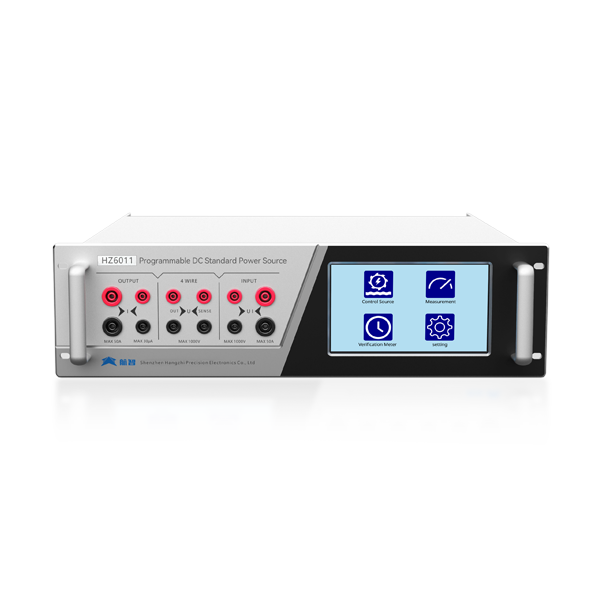
The HZ601 series from Hangzhi combines a programmable DC power source with measurement functions and a built-in DC-meter verification program. It can output voltage and current simultaneously, provide DC power and measure an input voltage or current. Voltage output spans 0–1100 V and current output 0–55 A, with manual adjustment over 0–110% RG and setting increments of 0.001% RG.
Its input ranges follow a separate list: 100 mV, 1 V, 10 V, 100 V and 1000 V for voltage; 1, 10 and 100 mA, then 1, 5 and 50 A for current. Measurement resolution is 0.001% RG.
The input maxima therefore differ from the output maxima, which matters when assigning the reading channel for an upper-range point. Even an integrated source-and-meter arrangement therefore needs a separate decision about the independent observation used for that particular point.
Apply the Deviation Formula at the Intended Level
For the Hangzhi HZ6011(HZ601 series), voltage-output deviation is 0.006% RD + 0.004% RG. Current-output deviation uses the same expression at currents of at least 1 mA, but changes to 0.018% RD + 0.012% RG below that threshold. A sub-milliampere point consequently belongs to a different stated condition, even though it remains within the source’s overall current coverage.
The reading-related and range-related terms need to remain separate in the comparison; the same nominal setting can have a different stated limit when the selected range changes the range-related numerical error contribution. A smaller reading does not remove the range contribution, while a fine setting increment describes adjustment rather than deviation.
Output stability is 0.005% per minute, adding a time-dependent specification to the experiment. The applicable deviation expression and the observation interval answer different questions about the recorded point.
Check the Reading Boundary When Voltage Increases
A programmable DC power source for a point above 1100 V requires a different output selection. The HZ6061A chassis model includes 1500 V and 3000 V ranges; the HZ6061B includes 2500 V and 5000 V ranges. The protective-enclosure HZ6061Y extends to 2000 V. The distinct range lists also include low-voltage points: 225 mV on HZ6061A and 375 mV on HZ6061B, alongside the higher-voltage ranges already identified.
Their adjustment covers 0–110% RG with 0.001% RG fineness, accuracy of 0.006% RD + 0.004% RG and stability of 0.005% per minute. Reading coverage must be checked independently: the HIU models considered here have DC voltage ranges only to 1000 V and AC ranges to 707 V. A 5000 V source point therefore falls outside their direct voltage-measurement range.
Trace the Current Reading into the Laboratory Record
For current comparison, the HIU600B, HIU1000B and HIU1500B respectively cover DC currents to 600, 1000 and 1500 A at 0.02% accuracy. Their AC limits are 424, 707 and 1000 A at 0.05% accuracy. A reference meter choice needs the appropriate DC or AC rating attached to the proposed measurement. The current range does not extend voltage-input coverage; each channel retains its own measurement limits.
The conductor passes through the measuring aperture, while RS232/RS485 interfaces transfer readings to a computer. Multi-point zero-flux sensing supports simultaneous single-phase AC/DC voltage and current, frequency, phase and active-power measurement. Automatic range selection and AC-ripple testing below 1 kHz add further measurement functions, each requiring the selected configuration to be identified.
Preserve the Conditions During Execution
Soft start on the Hangzhi HZ601 raises output from zero; overload protection limits current for approximately four seconds before shutdown. Software self-calibration is available without opening the enclosure. These functions belong in the equipment record alongside its operating conditions. The unit weighs no more than 15 kg, a separate practical consideration for the laboratory’s equipment arrangement.
The HZ601 operates at 10–35°C from AC 220 V ±10%, 50/60 Hz. The HZ606 operating conditions are 15–30°C and 30–80% relative humidity. Recording the applicable environment and any protection event keeps observations connected to the actual run rather than to an assumed uninterrupted output.
A completed laboratory point contains an identified setting, a reading from the device and an independently obtained comparison value. A point outside either range needs a different documented measurement configuration.
Their ranges, deviation conditions and observation interval establish whether the entries describe a useful comparison. The source and reading chain are selected together at that point, so the result remains connected to both the excitation actually available and the measurement coverage used to observe it.
