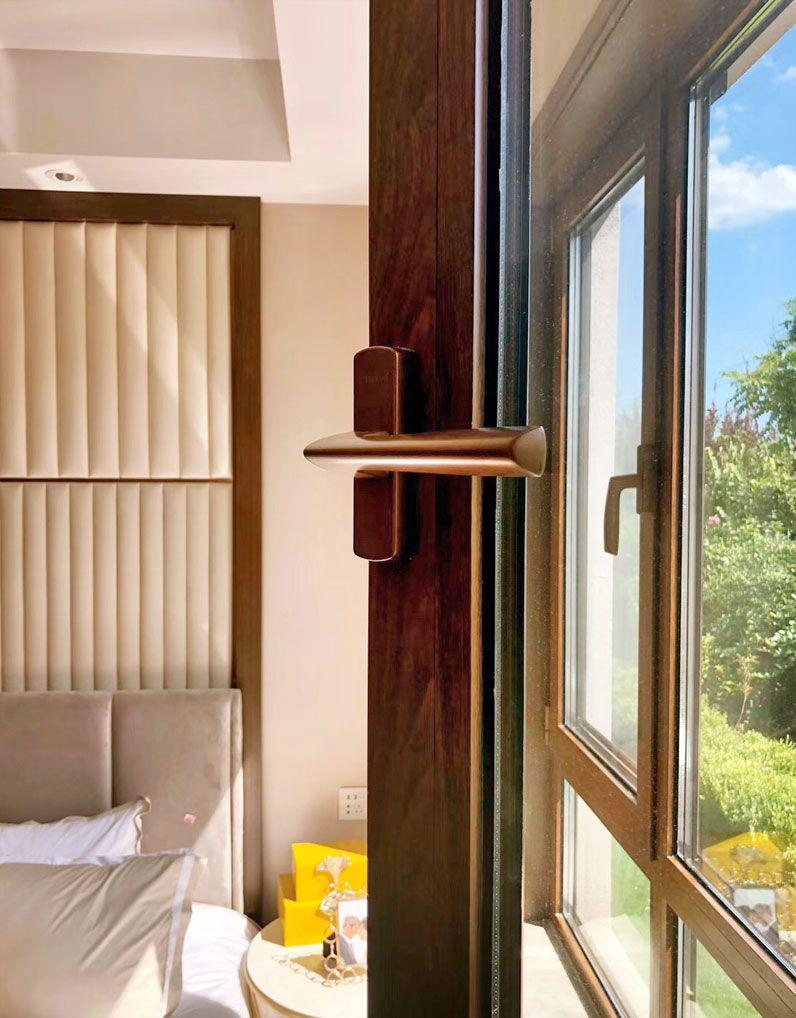
An inswing casement window creates a distinctive sealing geometry for architectural facades. The window sash closes inward against the frame, compressing the gasket from the interior side. This requires the weatherstrip to perform under a closing motion that pulls the sash toward the room. Such an action concentrates compression forces differently along the hinge side, lock side, and head jamb.
To address these structural variables, CMECH engineers specialized hardware with an extended transmission rod and enhanced drive strength. This targeted approach delivers coordinated multi-point compression across the entire sash perimeter. It ensures the inswing casement window weather-stripping is loaded evenly. Distributed force helps prevent low-pressure zones where wind-driven rain or thermal leakage might otherwise bypass the seal.
The Inswing Sealing Challenge and Perimeter Loading
Unlike outswing configurations where positive wind pressure assists seal compression, an inswing casement window relies heavily on internal hardware to generate closing force. The specified weatherstrip must demonstrate a strong ability to recover under repeated interior-directed compression. It is tasked with actively bridging the frame gap under dynamic loads rather than simply resisting exterior water impingement.
The hinge side of an inswing sash presents a particular mechanical challenge. The pivot axis creates a radial gap that changes dimension during standard operation. This geometry requires an inswing casement window weather–stripping profile capable of accommodating continuous variation without tearing. Simultaneously, the opposite lock side must safely absorb the high compression loads generated by the multi-point locking action.
Material Selection and Compression-Set Resistance
EPDM rubber is frequently utilized for architectural weather-stripping due to its broad temperature stability and reliable elastic recovery. However, varying formulations perform differently under cyclic compression imposed by daily window operation. Standard compounds may develop a permanent compression set within a few years, flattening at the contact patch and gradually compromising the intended weather seal.
For demanding applications, specifiers frequently prioritize closed-cell or dual-durometer profiles. These advanced designs combine a rigid carrier spine for dimensional stability with a soft sealing bulb for necessary conformability. CMECH hardware is engineered to generate consistent lock-point pressure across these profiles. This coordination ensures the gasket bulb compresses effectively without overloading the carrier material.
Multi-Point Locking and Uniform Gasket Compression
Standard single-point latches concentrate the entire closing force at one localized point. This setup can leave opposite corners of the sash under-compressed and highly susceptible to air infiltration. Multi-point hardware solution distributes the engagement load across multiple keeps positioned along the stile and head. This configuration translates handle torque into a coordinated sequence of compressive forces.
CMECH inswing casement hardware solution employs a multi-point locking system featuring rolling-friction engagement and durable stainless steel rivets. This design delivers notable anti-pry security while the extended transmission rod ensures lock points advance simultaneously. Synchronized compression helps prevent localized over-compression that might crush the gasket at the center, supporting a highly uniform seal across the entire frame.
Hinge Geometry and Pivot Axis Seal Continuity
The hinge side of an inswing sash can become a vulnerable perimeter point if pivot hardware solution interrupts the continuous gasket line. Should the hinge stack height unexpectedly exceed the specified gasket compression range, a bypass channel may form along the jamb. Such a persistent gap is difficult to mitigate regardless of the applied lock-side pressure.
CMECH addresses this architectural variable through adjustable hinge designs that allow precise gap setting between the sash and frame. This adjustability enables professional installers to align hinge-side seal compression with lock-side compression. When paired with compliant profiles and proper on‑site calibration, the 100 kg‑rated hinge assembly with multi‑dimensional adjustment helps the weatherstrip maintain consistent contact pressure around the critical hinge jamb area.
Adjustable Sealing Geometry for Seasonal Performance
Building frames shift seasonally due to thermal expansion, localized moisture cycling, and general structural settlement. These factors cause the sash-to-frame gap to vary slightly over the course of a year. A fixed weatherstrip profile can struggle to maintain a suitable compression ratio across this range, potentially leading to winter air leaks or summer gasket extrusion.
The CMECH inswing system incorporates highly adjustable hinge and lock mechanisms. These vital components allow field technicians to fine-tune the sash position and sealing pressure without disturbing the glazing layer. This adjustability supports the effective service life of the inswing casement window weather-stripping. It ensures the gasket operates within its targeted compression range even as surrounding frame geometry drifts.
Detecting Failure Through Hardware Symptoms
Weatherstrip degradation frequently manifests first through hardware symptoms rather than visually apparent gasket damage. Increased handle resistance often indicates that the gasket has lost elasticity, causing the lock cam to grind against the keep. Uneven lock-point engagement suggests that the gasket has compressed permanently on one side, subtly canting the sash and misaligning the interacting components.
Facility managers can monitor these mechanical signals to schedule proactive gasket replacement. By specifying CMECH hardware with its rigorous 30,000-cycle‑tested transmission component, maintenance teams retain a valuable mechanical safety margin. The adjustable lock geometry allows them to easily compensate for minor gasket degradation through incremental adjustment, effectively delaying full replacement and reducing long-term life-cycle maintenance requirements.
Coordinated Specification for Multi-Unit Developments
Specifying weatherstrip and operational hardware solutions from a single integrated system ensures the gasket durometer, compression ratio, and lock-point travel are properly calibrated. Mismatched components frequently produce subpar structural results. Pairing a high-durometer gasket with insufficient lock throw, or crushing a soft gasket with an overly aggressive cam geometry, directly leads to premature mechanical wear.
A cohesive specification strategy actively prevents these component conflicts in large-scale residential and commercial developments. By relying on thoroughly tested systems from CMECH, architects can achieve reliable building envelope performance. Coordinated hardware and sealing solutions provide a stable foundation for the long-term functionality of an inswing casement window in demanding contemporary architectural projects.
All hardware specifications, performance data and material parameters are sourced from CMECH official product manuals and certified test reports.
