Modern dental laboratories operate under strict standards for anatomical accuracy and turnaround speed. Restorative workflows, clear aligner manufacturing, and surgical guide production demand unwavering dimensional fidelity. Achieving these clinical benchmarks requires advanced additive systems tailored for specialized dental resins.
Margin line clarity and surface smoothness dictate the fit of indirect restorations. Microscopic discrepancies in physical models can cause costly seating adjustments or clinical refits. High-precision hardware mitigates these errors, ensuring predictable clinical outcomes across diverse restorative procedures.
Digital dentistry relies on reliable light engines to cure photopolymer resins with micron-level exactness. As clinical demand scales, laboratories evaluate production systems that combine rapid curing cycles with micro-level detail preservation to maintain consistent quality standards.
Precision Benchmarks for an Advanced LCD Resin 3D Printer
Selecting a high resolution resin 3D printer transforms daily laboratory operations by greatly reducing manual finishing steps. Precise light modulation ensures that intricate prep lines, undercut regions, and implant access channels are reproduced faithfully without geometric distortion.
Liquid crystal display technology has reshaped desktop additive manufacturing for clinical settings. An LCD resin 3D printer uses a pixel-based LCD masking system to expose each resin layer as a complete image, enabling consistent curing across the build area.
Unlike point-by-point scanning methods, this approach allows multiple parts to be printed simultaneously with exposure time primarily determined by layer height rather than the number of components on the platform.
Optical uniformity across the exposure area directly impacts physical dimensional stability. When light distribution remains constant, multi-unit prints exhibit zero batch variation. This level of repeatability proves crucial for complex full-arch models and removable prosthetics.
Advanced edge-smoothing algorithms further refine surface texture during the exposure process. By reducing visible step lines between layers, digital models require less post-processing, allowing technicians to proceed directly to thermoforming or crown fitting.
Technical Superiority of the RXDent-L230
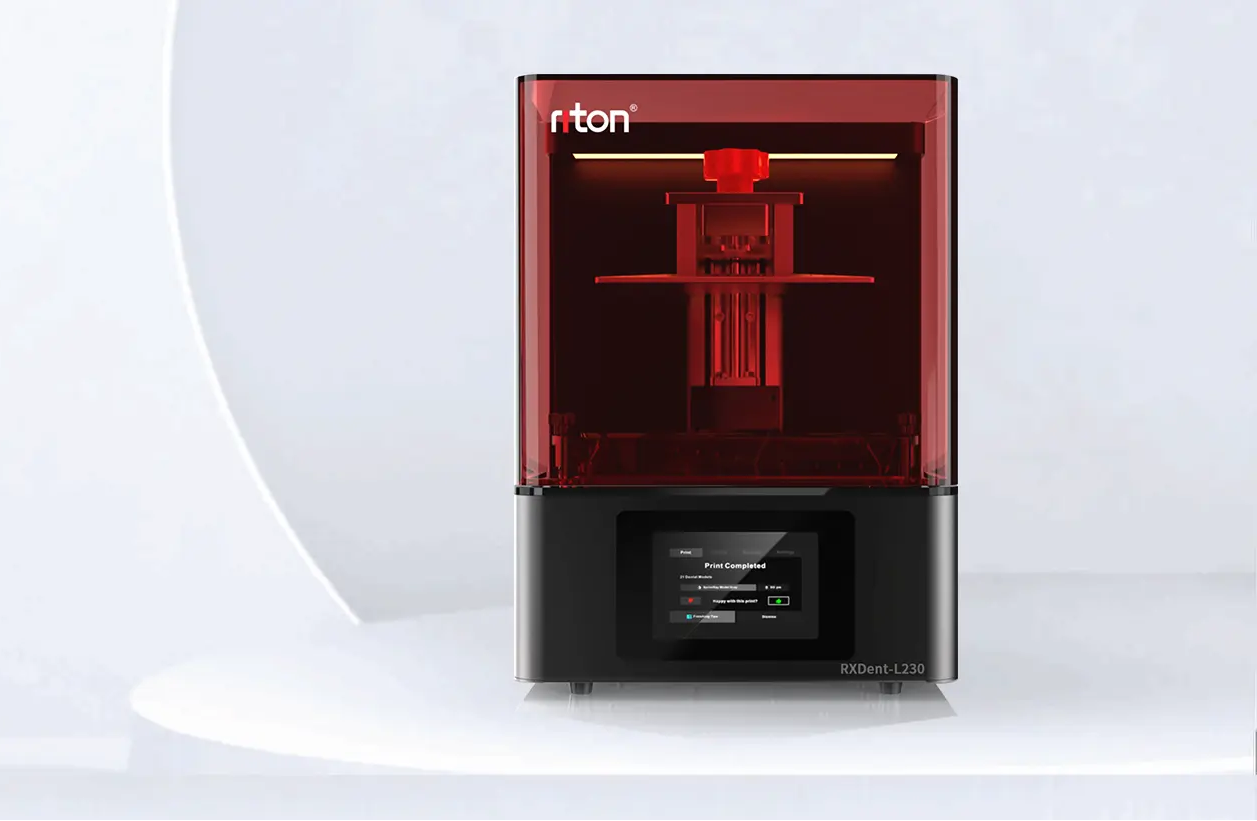
Developed by Riton, the RXDent-L230 represents an advanced approach to chairside and laboratory additive manufacturing. Backed by decades of laser and digital equipment engineering, this compact platform satisfies the rigorous operational requirements of experienced dental technicians.
The unit features an 8K monochrome display delivering a 7680 × 4320 pixel resolution. With an accuracy of 30μm, a high resolution resin 3D printer of this tier captures fine anatomical details essential for crown and bridge working models.
A generous build volume of 228 × 128 × 150 mm supports high-capacity production runs. Laboratories can print multiple full-arch models or die preps in a single unattended cycle, maximizing output without expanding the physical lab footprint.
Printing speeds ranging from 1 to 8 seconds per layer significantly reduce turnaround cycles. Combined with layer thickness settings between 0.01 and 0.2 mm, the machine provides extreme flexibility between ultra-fine resolution and rapid mass production.
Light source stability exceeds 90% uniformity, minimizing distortion across the outer margins of the build plate. The integrated RTware software handles slice preparation and parameter calibration, enabling seamless integration into established CAD/CAM digital infrastructure.
Clinical Solutions and Real-World Applications
High-precision resin processing serves a broad spectrum of clinical applications. From removable partial denture frameworks and implant surgical guides to clear aligner master models, exact physical reproduction ensures seamless clinical seating for dental patients.
LCD resin 3D printer enables workflow improvements for dental‑lab production. Optimized printing accuracy reduces potential remanufacturing risks and cuts bench‑time spent on manual die trimming and surface corrections for technicians.
Consistency across varying resin formulations is vital for versatile lab operations. The RXDent-L230 supports model resins, castable materials, and biocompatible resins for surgical guides, ensuring stable curing parameters across diverse clinical indications.
Consistent Z‑axis movement supports improved surface finish via precise drive mechanics, reducing visible layer‑line artifacts. Higher‑quality model surfaces help minimise friction during aligner thermoforming, supporting accurate contour replication required for orthodontic tooth‑movement planning.
Integrated Technical Services and Global Network
Selecting dedicated equipment requires evaluating the complete support infrastructure behind the machine. Riton brings decades of specialized digital dentistry expertise, positioning itself as a complete solution provider rather than merely a hardware vendor for modern dental practices.
Comprehensive pre-sales guidance helps facilities select optimal equipment parameters and software setups. Experienced application engineers assess existing digital workflows, ensuring new additive hardware integrates smoothly with current intraoral scanners and CAD design packages.
Robust post-sales technical support provides continuous operational security for busy laboratories. Direct technical assistance, routine parameter updates, and remote diagnostic tools prevent unplanned downtime and ensure consistent print quality across all shift operations.
A global distributor coordination network ensures localized service availability across international markets. Local technical representatives deliver prompt physical maintenance, spare parts distribution, and hands-on staff training, safeguarding long-term capital investments for dental enterprises.
Future Outlook for Dental Additive Manufacturing
The transition to fully digital restorative workflows depends on hardware accuracy and long-term reliability. Investing in a high resolution resin 3D printer allows growing facilities to scale production volume while maintaining strict quality control standards.
As material science advances, specialized photopolymer resins will require increasingly precise light control. Equipment engineered by Riton provides the optical accuracy, software flexibility, and thermal management necessary to process next-generation dental materials efficiently.
Adopting a professional LCD resin 3D printer establishes a strong foundation for scalable laboratory growth. Digital precision eliminates traditional casting errors, reduces material waste, and delivers reproducible results that satisfy demanding clinical requirements.
Ultimately, high-resolution resin technology empowers dental professionals to deliver superior patient care. Through reliable hardware performance and dedicated global support, modern additive systems continue to redefine productivity standards across the dental industry.
